Dr. de Clermont-TonnerrePlastic Surgeon

Paris 16th & Pontoise (95)

Ear Reduction

Macrotia correction — Paris 16th & Pontoise

Ear reduction surgery (macrotia correction) addresses auricles that are too large and disproportionate relative to the face. Through precise surgical reshaping, Dr. de Clermont-Tonnerre restores harmonious proportions with scars concealed within the natural folds. Performed in Paris 16th and Pontoise.

Book an appointment

Step by step

Procedure overview

01

Consultation

Assessment of the auricles, analysis of proportions, discussion of the desired result. Photographic simulation possible.

02

Pre-operative assessment

Standard blood tests. Anaesthetist consultation. Mandatory 15-day reflection period.

03

Procedure

Local or general anaesthesia. Duration 1 to 2 hours. Resection and reshaping of the cartilaginous and cutaneous structures of the ear. Scars in the natural auricular folds.

04

Hospital stay

Day surgery (outpatient). Protective dressing applied in the operating room, worn for a few days.

05

Follow-up

Suture removal at day 10. Definitive result at 6–12 months.

In practice

Duration
1 to 2 hours
Anaesthesia
Local or general
Hospital stay
Day surgery
Time off work
7 to 10 days
Definitive result
6 to 12 months
Fee
€5,000

Advantages

  • Harmonious and natural proportions
  • Scars concealed within the natural folds
  • Combinable with an otoplasty
  • Permanent results
  • Improved self-confidence

Risks

  • Post-operative haematoma
  • Residual asymmetry
  • Hypertrophic scar (rare)
  • Insufficient or excessive correction
  • Skin necrosis (exceptional)

Expected results

The ear regains natural proportions in harmony with the rest of the face. Scars, concealed within the auricular folds, become invisible over time. The impact on self-confidence is immediate.

Résultats

Avant / Après

Ear Reduction

Photos de patients du Dr. de Clermont-Tonnerre, partagées avec leur accord. Les résultats varient selon les individus et leur morphologie.
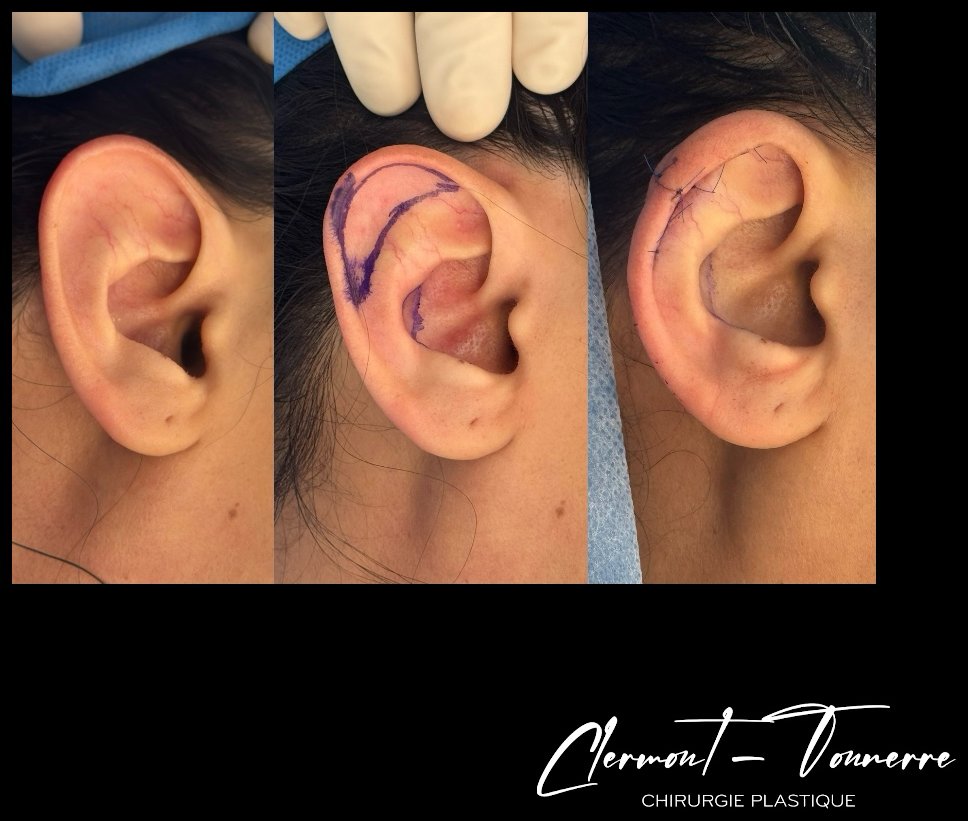
Before and after ear reduction (macrotia) — Dr. de Clermont-Tonnerre Paris

Frequently asked questions

What is macrotia?+
Macrotia refers to ears that are disproportionately large relative to the face. It may affect the entire auricle or only certain parts (earlobe, helix). Reduction surgery reshapes the ear to restore harmonious proportions.
Is ear reduction covered by insurance?+
Ear reduction is considered an aesthetic procedure and is not reimbursed by French Social Security in the vast majority of cases. A personalised quote is provided at the consultation.
What scars are left after ear reduction?+
Scars are placed in the natural folds of the ear and behind the auricle. They progressively become discreet and are virtually invisible at 12 months.
Can ear reduction be combined with correction of prominent ears?+
Yes, ear reduction can be combined with an otoplasty (prominent ear correction) if both issues coexist. Dr. de Clermont-Tonnerre assesses the most suitable combination during the consultation.
How does ear reduction differ from classic otoplasty?+
Classic otoplasty treats prominent ears by repositioning the auricle closer to the skull, without altering ear size. Ear reduction, or macrotia correction, addresses ears that are excessively large and involves partial resection of cartilage and skin to reduce the dimensions of the auricle. Both techniques can be combined if the patient has ears that are both prominent and oversized.
What is the price of ear reduction?+
The cost of ear reduction varies depending on the extent of the correction required (entire ear or partial correction of a lobe or helix), the type of anaesthesia, and the complexity of the case. A detailed personalised quote is systematically provided at the consultation. As a guide, the fee listed at the practice is €5,000. This procedure is not covered by the French Health Insurance.
Does ear reduction leave visible scars?+
Scars are carefully placed in the natural folds and creases of the auricle (concha, helix, retroauricular sulcus). They are therefore very discreet from the first few weeks. Over time and with good scar care, they become virtually invisible at 12 months. Dr. de Clermont-Tonnerre uses precise suturing techniques to minimise the risk of hypertrophic scarring.
What is the recovery after ear reduction?+
Recovery is generally straightforward. A protective dressing is applied in the operating room and worn for a few days. Swelling and bruising may persist for 10 to 15 days. It is advisable to sleep on your back for the first few weeks and to avoid any trauma to the ear. Non-absorbable sutures are removed at day 10. A slight temporary asymmetry due to swelling may be present; this resolves spontaneously. Time off work is generally 7 to 10 days.
Can only one ear be corrected?+
Yes, it is entirely possible to operate on only one ear if a significant size asymmetry exists between both auricles, or if only one is disproportionate. Dr. de Clermont-Tonnerre performs a comparative analysis of both ears at the consultation to determine whether correcting one side alone is sufficient to restore harmony, or whether a symmetrical procedure is preferable for a more balanced result.

Patient testimonials

My ears were too large and had been a source of self-consciousness since adolescence. Dr. de Clermont-Tonnerre perfectly reduced their size while maintaining a very natural result. I am delighted.

Aurélie

I had a particularly long earlobe that bothered me. The procedure was quick and the recovery very straightforward. The result is discreet and harmonious.

Thomas

Would you also like to correct prominent ears?

Otoplasty — Prominent ears →